
YOUR LOCAL PLUMBER IN
Port Coquitlam
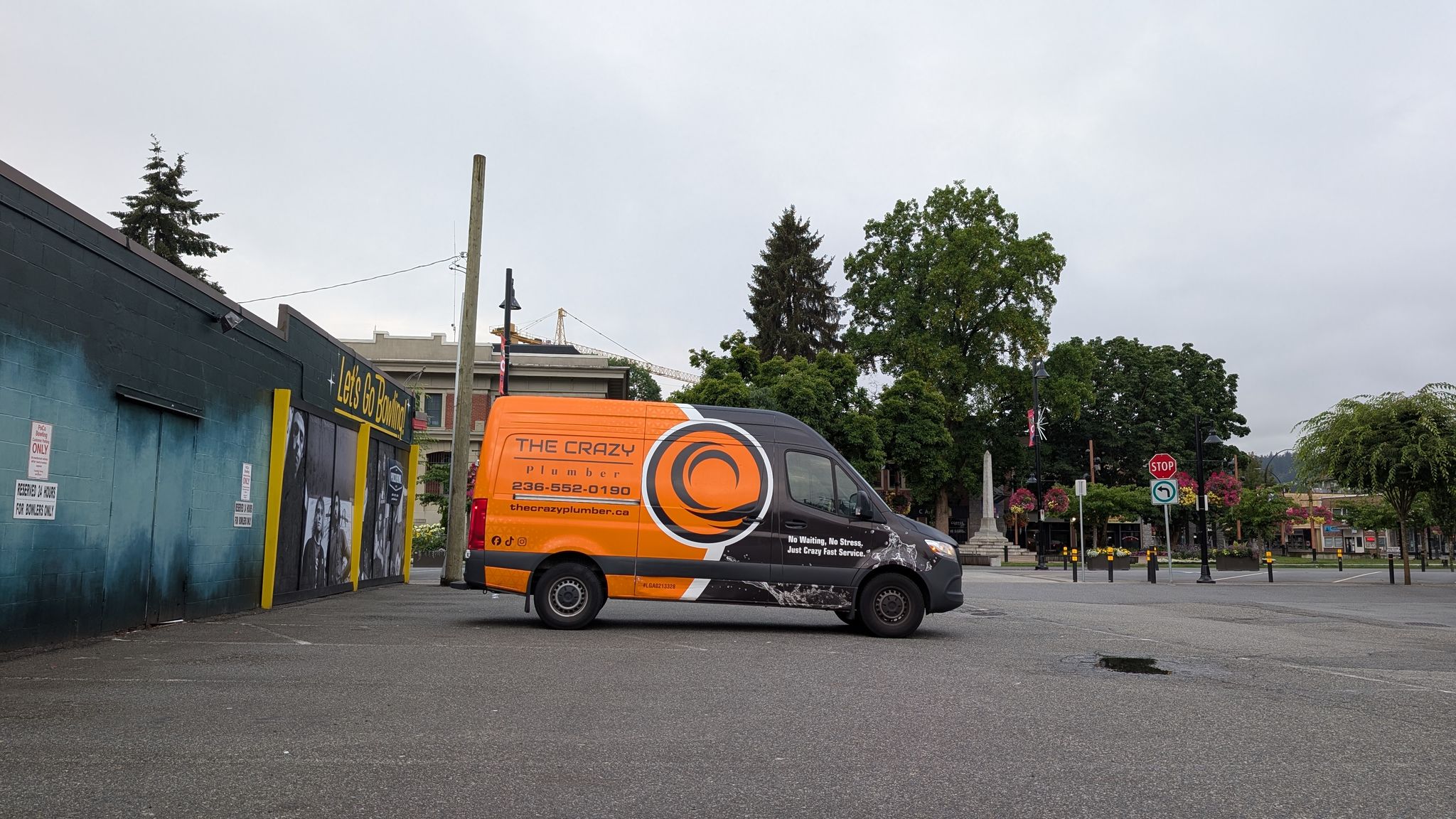
From the heritage storefronts of Shaughnessy Street to Citadel’s hillside homes and the wetlands of Blakeburn Lagoons Park, Port Coquitlam has more than one story to tell. Explore its neighbourhoods, landmarks and home styles, then find the plumbing service you need with The Crazy Plumber.

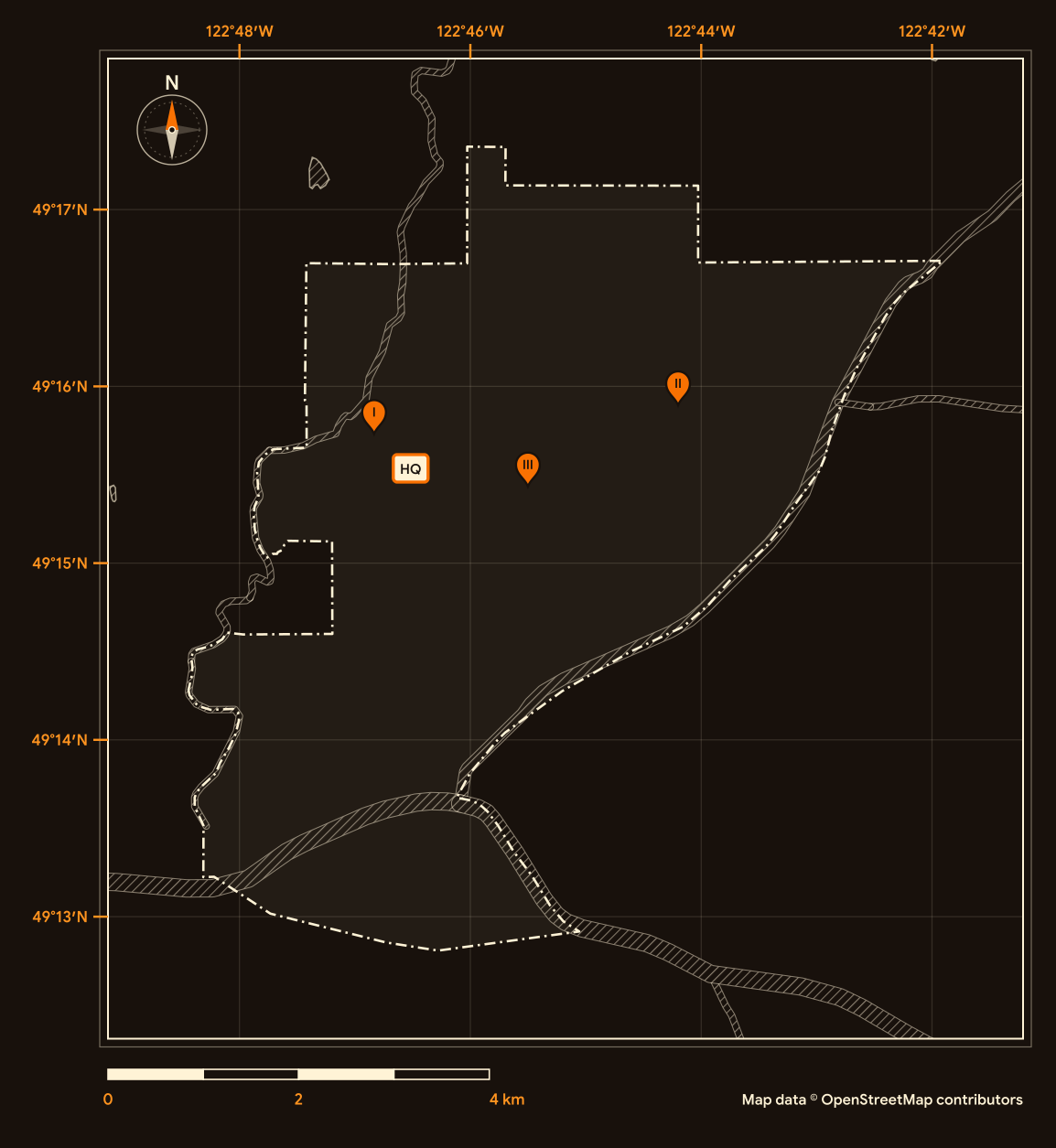
Legend
Surveyed by
The Crazy Plumber
Port Coquitlam HQ, serving all four regions
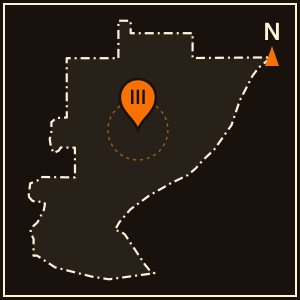
Pins I to III match the landmark plates; the dashed line is the city boundary. Map data © OpenStreetMap contributors (ODbL).
Location Landmarks
Three familiar places. Three different stories. Explore a heritage city hall, a restored lagoon park and a bridge over the rail yards.
Port Coquitlam City Hall
In 1985, City Hall was designated a heritage site.
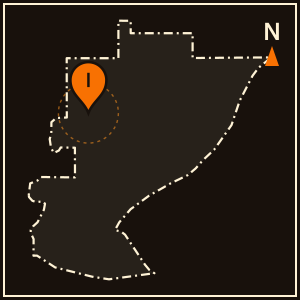

Blakeburn Lagoons Park
The park opened on April 28, 2018, and received a Sustainable Communities Award from the Federation of Canadian Municipalities that year.
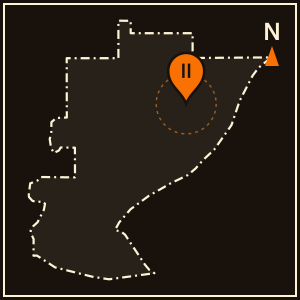
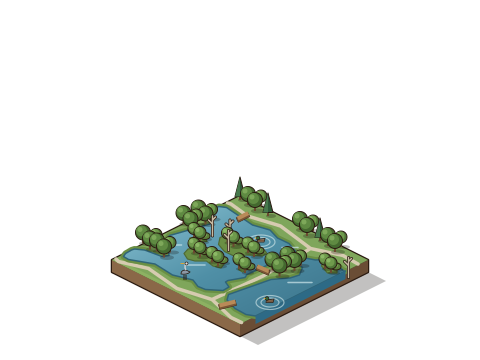
Coast Meridian Overpass
Prefabricated deck sections were launched over the piers so rail freight could keep moving below.

Your Home, Your Community, Your Plumber.
Ready to sort out your plumbing?
Tell us what is happening at home. Request a plumbing appointment online, or call to discuss the next step.
Credentials on file
Licence
TSBC Licence # LGA0213328
Better Business Bureau
Accredited · A+ ratingGoogle reviews
854
Founded
June 2023, Port Coquitlam
Estimates
Free estimates
Ryan was personable and friendly explained problem with kitchen faucet and had it repaired in minutes. Service was prompt and much appreciated. Thankyou Diana
Polite and prompt service from the Crazy Plumber. We had both Randeep and Karn help us out same day with a very tough clogged drain which was backing up. Thanks for the quick and clean resolution!
This is the second time we have hired this company and both times they did a great job. I called last night spoke to Brad and they were at my Dad's house by 8:45 a.m. the next morning. Tony did an incredible job today. He called on his way to give me his ETA, he arrived on time, he assessed the work and he provided me with prompt and very clear quotes with an explanation to me in a way I could understand. He completed the work and did a terrific job of it. So happy and relieved that the issue is fixed. He also provided some quotes for some other things in the home that need to be fixed as well and we will proceed with those in the near future as well. I work at a service company and this company and Tony specifically, did a fantastic job. What a friendly and well run business. Thank you! I highly recommend The Crazy Plumber and believe in leaving a great review when I receive great service.
Karn did an excellent job fixing a messed up shower tap/diverter thing. He is polite, knowledgable and very tidy. Even cleaned the hair clumps out of the drain (not my hair). Did a great job, thank you.
Location Data
See how Port Coquitlam grew, what kinds of homes it has, how old they are and who calls it home. Explore five views of the 2021 Census.
Residents
61,498
Earlier census
58,612
Census year
2021
Comparison year
2016
People per square kilometre
2,108.7
Land area (km²)
29.2
Private dwellings
23,671
Occupied by usual residents
22,884
Average household size
2.6
Households of one person (%)
22.7
Median age in years
41.6
Ages 0 to 14 (%)
15.7
Ages 15 to 64 (%)
68.6
Ages 65 and over (%)
15.7
Average age in years
41.3
Ages 85 and over (%)
1.8
Single-detached (%)
36.7
Apartments, 5 or more storeys (%)
1.8
All other home types (%)
61.6
Households that own (%)
77.1
Households that rent (%)
22.9
Median home value, owner-estimated
$900,000
Built 1981 to 2000 (%)
40.7
Homes built 1981 to 2000
9,315
Built before 1981 (%)
32.9
Built 2001 to 2021 (%)
26.4
Needing major repairs (%)
4.5
Homes needing major repairs
1,025
Historical Timeline
A rail town incorporates, industry and suburbs arrive, and commuter rail links the city to the region. Explore three turning points that helped shape Port Coquitlam.
1913
A rail town becomes a city
On March 7, 1913, the area around the Canadian Pacific Railway’s Pacific Coast Terminal was incorporated as the City of Port Coquitlam, with James Mars as mayor. Incorporation was celebrated with a formal ball at the Agricultural Hall, known as Aggie Hall.
1959
Industry and suburbs grow
Lougheed Highway was completed along the north side of the Fraser River in 1951. In 1959, Esco Ltd. opened a steel foundry, and by the early 1960s Mary Hill was being developed for residential subdivisions.
1995
Commuter rail arrives
Port Coquitlam Station opened in 1995 at 2125 Kingsway Avenue, beginning West Coast Express commuter rail service. The following year, the Mary Hill Bypass was widened to four lanes.
Neighbourhoods
Explore three different sides of Port Coquitlam: Mary Hill, Downtown and Citadel. Choose a neighbourhood to see its homes, streets and setting.
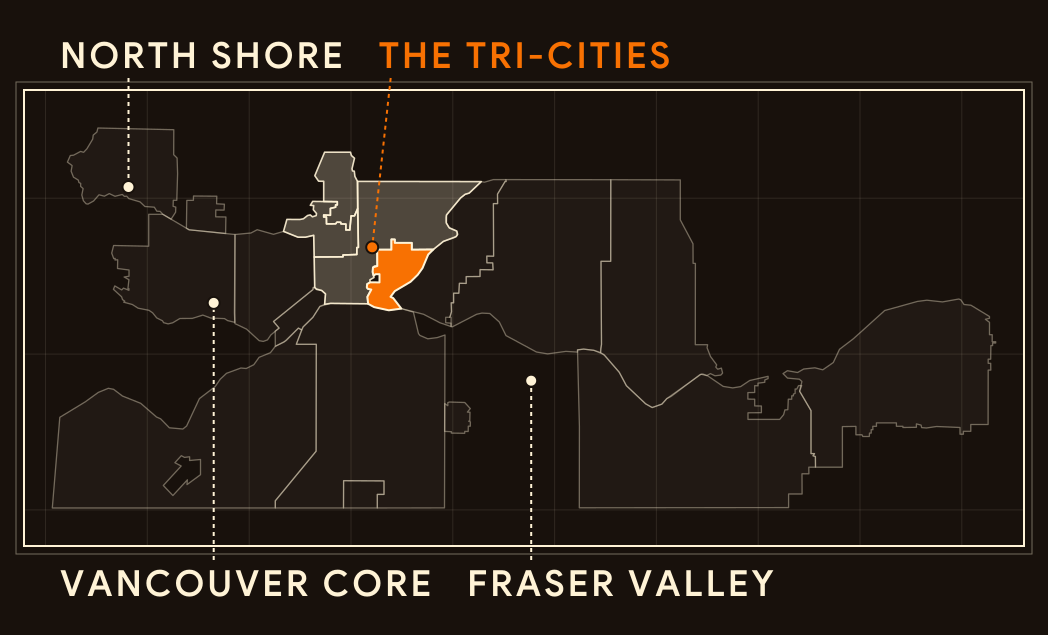
Regional key
The Tri-Cities
Map data © OpenStreetMap contributors (ODbL)
Mary Hill
A neighbourhood of 1960s and 1970s family homes, built as the city grew after the war.
Homes
Homes from the building boom
Small local builders put up speculative homes here in the 1960s, often repeating one design, with a chalet-style entrance, on lots that were not always side by side.
Streets
From bush to suburb
The quarry and bush lands on Mary Hill became new, affordable housing in the late 1960s. In the census tract around Mary Hill Elementary, 51.4 percent of homes date to 1961 to 1980.
Setting
Between road and river
The area is bounded in part by Pitt River Road and the Coquitlam River, with parks such as Robert Hope Park and Skyline Park.
Downtown Port Coquitlam
The city’s commercial and civic core, with a traditional main street along Shaughnessy Street.
Homes
Homes near the main street
Low-rise condominiums and townhouses sit near heritage commercial buildings. In the tract around City Hall and Port Coquitlam Station, 87.3 percent of homes were in apartment buildings under five storeys in 2021.
Streets
A main street that moved
A 1920 fire and a 1921 flood hit the old business district on Dewdney Trunk Road, now Kingsway Avenue, and sped the move of businesses to Shaughnessy Street. The 2300 to 2600 blocks keep a main street streetscape.
Setting
Linked across the tracks
The Shaughnessy underpass, on the site of the old level crossing, links the historic core with northern districts beneath the railway corridor.
Citadel
A master-planned community on the upland bluffs above the Fraser River, in southwestern Port Coquitlam.
Homes
A planned subdivision
Citadel is one of the city’s planned subdivisions, built in a coordinated way on large tracts of former bush and quarry land on Mary Hill. In the Citadel census tract, 86.1 percent of homes were built from 1981 to 2000.
Streets
A road along the edge
The Mary Hill Bypass skirts the neighbourhood’s southern edge. It was established in 1986 and widened to four lanes in 1996.
Setting
A hill with a history
Citadel sits on Mary Hill, a 122-metre landform named after Colonel Richard Moody’s wife, Mary. The Royal Engineers saw the hill as a site for a citadel to defend New Westminster.
Builders and Developers
Meet two early builders whose work helped shape Port Coquitlam. Follow each story from material to building and the places people recognise today.
J. E. Parr and Parr, Mackenzie & Day
Material
Brick for a new city.
Vancouver architect J. E. Parr, of Parr, Mackenzie & Day, designed Port Coquitlam’s three-storey brick City Hall in 1914. The firm also designed a hotel and stores for the Coquitlam Terminal Company in 1913 to 1914.
Building
A hall that grew with the city.
The 1914 hall has heavy timber framing inside load-bearing walls of Nanaimo brick. In 1988 a three-storey rear addition, joined by a glazed atrium, doubled the building’s size.
Community
A landmark for the community.
City Hall is listed on the City’s Heritage Register, which also includes the Rowland Lacrosse Box. Terry Fox was invested into the Order of Canada there on September 18, 1980.
Coquitlam Terminal Company
Material
Land for a rail town.
From 1911, the Coquitlam Terminal Company developed land and built homes, promoting the industrial hub around the railway terminal.
Building
Bungalows, a hotel and stores.
The company built craftsman bungalows to attract industry, and Parr, Mackenzie & Day designed a hotel and stores for it in 1913 to 1914. Early Port Coquitlam houses favoured careful detail over size.
Community
A character that remains.
The 1985 heritage inventory recorded 20 craftsman-style residences, a dozen of them built before the First World War. 1983 Manning Avenue, from 1913, is one example.
Styles of Homes
Recognise that roofline? Choose a home style, then explore the details that connect it with Port Coquitlam.
1900s to the 1920s
Craftsman character
Early Port Coquitlam favoured the craftsman bungalow, where modest scale and decorative woodwork mattered more than size.
Built to attract industry
The Coquitlam Terminal Company, begun in 1911 to promote the area as an industrial centre, built a number of Craftsman bungalows in a bid to attract industry.
Addresses worth noticing
1983 Manning Avenue, from 1913, is a Craftsman-style house. 2272 Kelly Avenue, a 1911 Craftsman bungalow, served as the Anglican Church’s first vicarage in the city.
A small surviving group
The 2021 Census counted 150 occupied dwellings from 1920 or before. The 1985 heritage inventory recorded 20 craftsman-style residences.
1960s
The same house, again and again
In the 1960s, small local builders put up speculative houses on Mary Hill, repeating the same design with a chalet-style entrance on lots that were often not side by side.
Brand new and affordable
The City’s heritage inventory describes brand new, modern, affordable housing on Mary Hill and in Sun Valley in the late 1960s, as suburbs replaced woodland and farmland.
Spot the repeat
Look for the same house form and details on lots across the hill. The inventory notes a familiar refrain on tours of these areas: “Oh, there’s our house!”
A form, not a census category
The 2021 Census counted 2,655 occupied dwellings in Port Coquitlam built from 1961 to 1970. That total includes all home types and should not be read as a count of any one design.
1980s and 1990s
A planned neighbourhood
In 1978, Genstar Development Company proposed developing a site of about 123 hectares on Mary Hill that included the old gravel pit. Citadel Heights held its grand opening in June 1986.
Planned as a whole
The City’s heritage inventory lists Citadel as an example of planned subdivisions: bush lands and industrial sites turned into residential communities built in a coordinated way on large tracts of land.
From quarry to homes
Gilley’s Quarry, a Mary Hill gravel pit and once a major local employer, is now the site of Citadel Landing.
Growth in the 1980s and 1990s
The 2021 Census counted 3,765 Port Coquitlam homes built from 1981 to 1990 and 5,550 built from 1991 to 2000. Those totals include all home types.