
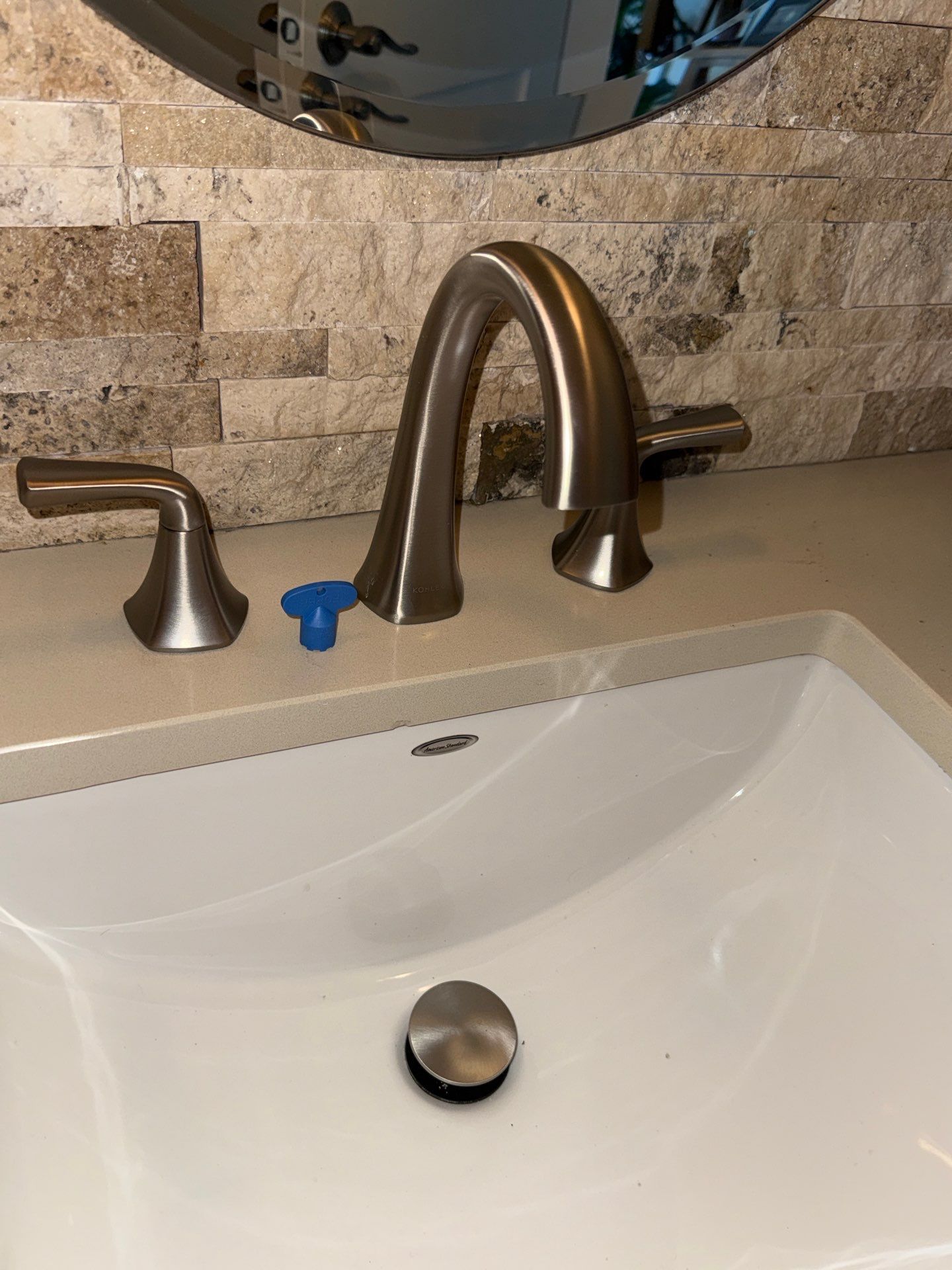
Bathroom Faucet Repair
Services offered in: Tri-Cities, Vancouver Core, The North Shore, and The Fraser Valley
If your bathroom faucet is loose, stiff, weak, noisy, or difficult to shut off, you may be able to repair it instead of replacing the whole fixture.
What We Do
- Ask what changed, when the problem began and whether other fixtures are affected.
- Check hot and cold flow, the aerator, shutoffs, supply connectors, handle operation and mounting.
- Identify the faucet's serviceable parts and assess condition, access and parts availability.
- Explain whether a targeted repair or a separate replacement service is appropriate.

Same-Day Service
Free Quotes
Free Estimates
Crazy Fast Plumbers
About this service
Bathroom Faucet Repair
If your bathroom faucet is loose, stiff, weak, noisy, or difficult to shut off, you may be able to repair it instead of replacing the whole fixture. This service covers general bathroom sink faucet problems that affect how the fixture works, without an active leak that is damaging the vanity or floor.

What This Service Solves
Bathroom Faucet Repair solves fixture problems that make the faucet annoying, unreliable, weak, stiff, or hard to use. Most of these issues begin inside small working parts that wear down long before the whole fixture needs to come out. A worn cartridge can make the handle stiff or loose. A clogged aerator can turn clean flow into a crooked spray. Mineral grit or pipe debris can reduce hot or cold flow. A loose mounting nut can let the whole faucet shift on the sink deck.
The goal is not to sell a new faucet by default. The goal is to find out whether the existing faucet has serviceable parts, whether those parts are worth replacing, and whether the fixture can return to reliable use without wasting money. A good faucet often deserves repair. A bargain fixture with failing internals may not.
The Difference Between Repair and Leak Repair
Bathroom Faucet Repair covers general malfunctions such as a loose handle, weak flow, gritty movement, a clogged aerator or a faucet that shifts on the sink deck. The water may still shut off, and there may be no visible water damage. The work starts with diagnosis and a repair-versus-replacement decision.
Faucet Leak Repair covers active water, including a dripping spout, water pooling at the base, a tub spout that will not stop running or a shower spout that continues after the handle is turned off. Active leakage deserves faster attention because the water can damage cabinets, finishes or spaces below.
How a Bathroom Sink Faucet Works
A bathroom faucet is a small valve system mounted through a sink, vanity top, or countertop. Water arrives through hot and cold supply lines, passes through shutoff valves under the sink, enters the faucet body, moves through a cartridge or stem assembly, and exits through the spout. On many modern faucets, a single cartridge controls both temperature and flow. On two-handle faucets, each side usually has its own cartridge, stem, washer, or ceramic disc assembly.
The visible fixture is only part of the system. Under the sink, mounting nuts hold the faucet tight to the deck. Flexible connectors or integral faucet tails connect the fixture to the shutoffs. The aerator at the end of the spout shapes the stream and catches grit. When one piece wears, sticks, or clogs, the whole faucet feels wrong.
That is why a proper repair starts with the system, not just the handle.
Common Bathroom Faucet Problems
A loose handle usually comes from a worn set screw, stripped handle adapter, loose cartridge retaining nut, or wear inside the cartridge itself. Tightening the handle may help for a day, but if the handle keeps loosening, the working part underneath needs inspection.
Weak flow usually comes from a clogged aerator, partially closed shutoff, debris lodged in the supply connector, or a cartridge inlet blocked with grit. In a bathroom, this often shows up after work elsewhere in the house. A valve gets disturbed, debris breaks loose, and the smallest screen in the system catches it.
A stiff handle points to a cartridge that is drying out, scaling internally, or binding. Forcing it is a poor plan. Handles are designed for hand pressure, not a grip-and-twist contest.
A faucet that shifts on the sink deck usually means the mounting hardware underneath is loose, corroded, or poorly installed. Left that way, movement stresses the supply connections and opens small gaps where water from normal sink use can work under the fixture.
Signs to Watch For
Watch for a handle that feels loose, stiff, gritty, or uneven through its travel. A clean faucet handle should move predictably and stop positively. If it suddenly needs more force, something changed inside.
Watch for weak flow from one side only. If hot is weak and cold is normal, or the reverse, the problem is likely local to the faucet, the shutoff or the supply connector. A broader pressure problem is more likely to affect multiple fixtures.
Watch for crooked flow, spitting, or a spray that comes out sideways. That points to the aerator or debris at the spout. It is minor until someone ignores it long enough for the faucet to become unpleasant to use.
Watch for faucet movement on the sink deck. A faucet that rocks every time it is used is not just irritating. It is stressing the parts below the counter.
Watch for repeated handle adjustment. If someone in the house has developed a special technique to make the faucet behave, schedule service.
What Happens If You Ignore It
A bathroom faucet problem usually starts as a nuisance and turns into wear. A stiff cartridge makes people force the handle. Forcing the handle damages handle adapters, set screws, and sometimes the faucet body. A simple cartridge repair can become a replacement because the visible hardware was damaged after the first symptom appeared.
Weak flow can hide a different problem. If the shutoff valve under the sink is failing internally, the faucet may be the first place the issue shows up. If debris keeps returning to the aerator, the supply line or piping may be shedding material. That is worth knowing before it becomes a bigger fixture problem.
A loose faucet allows movement at the sink deck. Even if the faucet itself is not leaking, water from handwashing collects around the base, slips under the fixture, and sits against the vanity top. Many bathroom vanities are particleboard under a decorative finish. They swell quietly, then permanently.
What The Crazy Plumber Checks
The Crazy Plumber starts by asking what changed and when. Did the faucet become weak after other plumbing work? Did the handle get stiff over weeks? Did the faucet start moving after a vanity change? The story helps narrow the problem before tools come out.
On site, we check hot and cold flow separately, remove and inspect the aerator, test the shutoff valves, inspect the supply connectors, check the faucet mounting from below, and run the handle through its full range. If the faucet has a cartridge, we identify the cartridge type. If it has stems or washers, we check each side individually.
In a condo, townhouse or other multi-unit building, we also confirm whether fixture shutoffs are controlled within the unit and whether building procedures affect access. Tight cabinets and renovated vanities can limit access to mounting hardware and supply connections.
We also look at the condition of the fixture itself. A serviceable faucet with suitable replacement parts may be repairable. A corroded fixture or one without reliable parts support may not be worth the labour. You get that answer before money is spent on the wrong path.
What The Crazy Plumber Repairs
The repair depends on the diagnosis. For a weak-flow faucet, the fix may be cleaning or replacing the aerator, flushing debris from the supply, clearing cartridge inlets, or replacing a failing shutoff valve. For a stiff or loose handle, the fix may be a cartridge, stem, handle adapter, set screw, retaining nut, or trim piece.
For a faucet that moves on the sink deck, we tighten or replace mounting hardware when access allows and the fixture is still worth saving. If the underside is too corroded, or if the faucet body has been moving long enough to damage the sink opening, replacement may be the honest recommendation.
For a faucet with hot and cold reversed, uneven temperature control, or a handle that no longer lands where it should, we inspect the cartridge orientation and valve internals. That issue can be simple, but guessing wastes time.
Repair or Replacement: The Honest Math
Not every bathroom faucet is worth repairing. That does not mean every faucet should be replaced. The honest answer depends on quality, age, parts availability, finish condition, and labour access.
A well-built faucet may be worth a cartridge or stem repair. If the body is solid, the finish is intact and a suitable part is available, repair may offer better value than replacing the complete fixture.
A low-grade faucet with a failing finish, plastic internals, and hard-to-find parts is a different story. Spending service time to chase an unavailable cartridge is not good value. In that case, Bathroom Faucet Replacement gives the homeowner a cleaner result, better parts support, and less repeat frustration.
The Crazy Plumber explains both paths. If repair is the smart move, we repair. If replacement is smarter, we say so before pretending a weak repair will age well.
When to Schedule Bathroom Faucet Repair
Schedule service when a handle becomes loose, stiff, or unreliable. Schedule service when flow drops at one bathroom sink while the rest of the house is normal. Schedule service when the faucet shifts on the sink deck. Schedule service when the aerator clogs repeatedly after cleaning. Schedule service when hot and cold do not behave the way they used to.
You do not need to wait until the faucet leaks. Waiting turns small mechanical issues into fixture damage. It also leaves the household working around a faucet that everyone uses daily.
If water is actively dripping from the spout, pooling at the base, running under the sink, or coming from a tub or shower spout that will not shut off, choose Faucet Leak Repair instead. That service focuses on finding and stopping active water.
What Homeowners Can Check First
There are a few safe checks homeowners can do before booking. Unscrew the aerator by hand if it comes off easily, rinse the screen, and see whether flow improves. Do not use pliers directly on a finished aerator unless you are willing to mark it. Wrap it with a cloth if needed.
Check whether the issue affects hot, cold, or both. If only one side is weak, make a note. If both sides are weak only at that sink, the faucet or its supply connections are the likely location.
Look under the sink with a flashlight while the faucet runs. You are not diagnosing the whole system, just checking for obvious moisture. If you see water, stop and treat the issue as a leak.
Do not force shutoff valves that feel frozen. A seized valve can break in the open position, which is a poor way to start a faucet repair.
Related Services
Choose Faucet Leak Repair when water is actively dripping, pooling or escaping from a bathroom sink, tub spout or shower spout.
Choose Bathroom Faucet Replacement when the old faucet has reached the end of its useful service and the new fixture will use the same mounting location.
Choose Bathroom Faucet Installation when a new fixture needs a different mounting configuration, a first-time setup or plumbing coordinated with a renovation.
Choose Bathroom Sink Installation when the sink, vanity, mounting, drain assembly and faucet need to be coordinated together.
A loose, weak, stiff or unreliable bathroom faucet is worth diagnosing before extra force or continued movement damages more parts. The Crazy Plumber will inspect the fixture, explain the fault and help you compare repair with replacement.
Schedule Your Plumber or Call The Crazy Plumber at (236) 552-0190.
Service details
- Tri-Cities
- Vancouver Core
- North Shore
- Fraser Valley
Spot the signs
Signs Your Bathroom Faucet Needs Repair
- The handle feels loose, stiff, gritty or unpredictable.
- Flow becomes weak at one bathroom sink while other fixtures remain normal.
- Hot and cold flow behave differently at the same faucet.
- The stream sprays unevenly or the aerator repeatedly collects debris.
- The faucet moves on the sink deck.
- The fixture needs repeated adjustment to work normally. Active escaping water belongs in the Faucet Leak Repair pathway.
Job steps
How We Assess and Repair a Bathroom Faucet
- Ask what changed, when the problem began and whether other fixtures are affected.
- Check hot and cold flow, the aerator, shutoffs, supply connectors, handle operation and mounting.
- Identify the faucet's serviceable parts and assess condition, access and parts availability.
- Explain whether a targeted repair or a separate replacement service is appropriate.
- Complete the agreed repair and check operation, stability and connections.
Before you book
Questions homeowners ask
Cartridges, stems and aerators are common repair points. A worn cartridge can make the handle stiff, loose or hard to shut off. A clogged aerator can make the faucet feel weak even when the house pressure is fine. The Crazy Plumber checks the simpler causes first, then moves inward when the evidence points there.
When one faucet is weak and the rest of the home is normal, the problem is usually local. It may be a clogged aerator, a partially closed shutoff, debris in the supply connector, or a cartridge inlet blocked with grit. Whole-house pressure problems usually affect several fixtures, not one sink.
Often, yes. A loose handle may need a set screw tightened, a handle adapter replaced, a cartridge secured, or a worn cartridge replaced. If the handle hardware is stripped or the faucet body is damaged, replacement may make more sense. We inspect before recommending either path.
It depends on the faucet. A well-made fixture with available parts may be worth repairing, even after many years. A low-grade faucet with a failing finish, worn body, or no parts support may not be. The honest test is whether the repair buys reliable service or only delays replacement for a short period.
Call crazy plumber to do a call for me from my toilet and I have a service manager named Ryan and he was an awesome technician. Thank you again Ryan.
Called today with a leaking toilet and they were able to fit me in after 5 PM on a Saturday. Jordon was friendly, professional, and took the time to explain what he found and answer my questions. The work was completed efficiently, everything was cleaned up afterward, and it's all working perfectly. Thanks again, Jordon!
Brad came over at short notice to check a leak in our faucet. It was an easier fix than we anticipated and Brad fixed it for no charge. Appreciated the honesty as we had been quoted a ridiculous amount by another local plumber. Will definitely use the Crazy Plumber for future plumbing needs.
Book online
Randeep provided excellent service from start to finish. Arrived on time, quickly diagnosed the issue, and completed the repair professionally. Everything was explained clearly, and the work was done neatly with no mess left behind. Fair pricing and great communication. Highly recommend for any plumbing needs!