
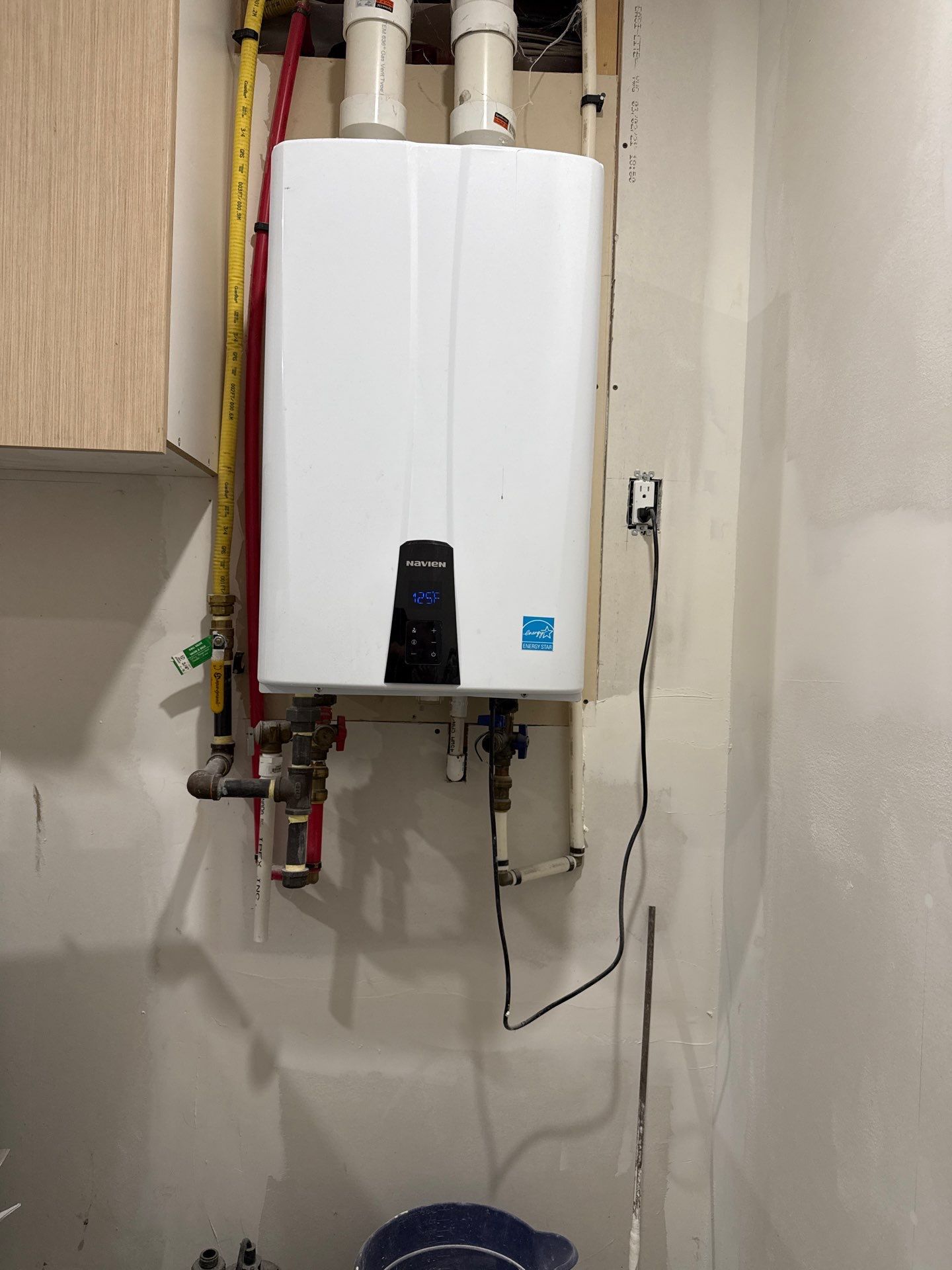
Tankless Water Heaters
Services offered in: Tri-Cities, Vancouver Core, The North Shore, and The Fraser Valley
Tankless water heaters heat water as it flows through the appliance rather than storing a tank of heated water. This changes the way capacity, comfort, installation and maintenance are evaluated.

Same-Day Service
Free Quotes
Free Estimates
Crazy Fast Plumbers
About this service
Tankless Water Heaters
Tankless water heaters heat water as it flows through the appliance rather than storing a tank of heated water. This changes the way capacity, comfort, installation and maintenance are evaluated.
The useful question is not whether tankless is universally better. It is whether a compatible tankless system fits the household’s simultaneous demand, property infrastructure, space, comfort priorities and ownership plans. This page explains the comparison, and Tankless Water Heater Installation covers the installation assessment.

How Tankless Water Heating Differs from Storage
A storage water heater keeps a reservoir available for use. A tankless unit activates when it detects flow and heats water through the appliance as demand continues. The exact burner, heat exchanger, controls, activation flow and operating sequence vary by model.
Tankless equipment does not provide unlimited flow. It provides continuous heating only within the selected unit’s rated capacity at the required temperature rise. If simultaneous demand exceeds that capacity, flow or outlet temperature can be affected.
Because there is no storage tank, tankless equipment changes the leakage profile and may free floor space. It does not remove water connections, maintenance needs, gas or electrical requirements, venting, condensate or the risk of component and piping leaks.
Condensing and Non-Condensing Equipment
Condensing and non-condensing equipment handle exhaust heat differently. This can change efficiency, venting, condensate, drainage and installation requirements. Exact heat-exchanger materials, efficiency ratings, vent materials and condensate treatment depend on the selected model.
The homeowner decision should compare compatible equipment and full installation scope rather than assume one design is automatically suitable for every property.
Indoor and Outdoor Options
Indoor and outdoor availability depends on the manufacturer, model, climate rating, freeze-protection requirements, location, clearances, access and applicable rules. Indoor equipment has model-specific intake and exhaust requirements. Outdoor equipment still needs suitable water, gas and electrical connections and protection from site conditions.
Do not select the location from a general rule. Confirm the chosen model’s instructions and the actual property conditions.
Infrastructure That Can Decide the Fit
Gas supply. Gas-fired tankless equipment can have materially different demand from the existing appliance. The meter, regulator, piping and other connected appliances must be assessed against the selected model. Exact pressure and pipe-capacity decisions require current equipment and utility information.
Venting. Vent material, diameter, length, slope, elbows, intake and terminal clearances are model- and installation-specific. Existing storage-heater venting should not be assumed compatible.
Electrical supply. Controls, fans, pumps and freeze-protection functions vary by model. The available electrical supply and outage implications belong in the comparison. Fixed electrical work is completed or coordinated by an appropriately licensed electrical contractor where required.
Water pressure and system conditions. Pressure, flow, thermal expansion, filtration, recirculation and fixture behaviour can affect compatibility. Exact limits and component requirements depend on the selected unit and plumbing configuration.
Drainage and condensate. Condensing equipment can require drainage and model-specific condensate treatment. The route and disposal method must suit the property and applicable requirements.
What Changes Cost and Complexity
The main cost drivers are the selected equipment, simultaneous demand, gas infrastructure, venting route, condensate drainage, electrical work, water connections, access, finished surfaces, recirculation and applicable authorizations.
A storage-tank replacement can have a simpler scope than a tank-to-tankless conversion. Tankless may still fit when the supporting work serves the homeowner’s space, comfort or long-term plans, but no universal cost multiplier, savings figure, lifespan or payback rule decides the comparison.
An installation may qualify for current utility or provincial incentives. Eligibility must be checked against the live program, customer type, utility, equipment and installation date.
A Storage Tank May Fit Better When
- Demand is modest and the current storage approach works well.
- Existing infrastructure strongly favours a similar tank replacement.
- The tankless supporting work is extensive relative to the benefits the homeowner values.
- Outage behaviour, maintenance preferences or a simpler installation scope favour storage.
- A heat pump or other electric storage option better fits the property’s energy and installation conditions.
Recirculation and Wait Time
Tankless does not automatically provide immediate hot water at distant fixtures. Pipe length, stored cool water, activation and controls still affect wait time. Recirculation options vary by model and plumbing layout and can change energy use, maintenance and warranty treatment.
Questions to Answer Before Choosing Tankless
- What simultaneous hot water demand should the system serve?
- Which incoming-water temperature and desired outlet temperature will be used for sizing?
- Can the property support the selected gas or electrical demand, venting, condensate and water connections?
- How important are floor space, leakage consequence, outage behaviour, wait time and recirculation?
- What maintenance does the selected model require for the property’s water conditions?
- How do the full tankless and storage-tank scopes compare?
If tankless still fits after this comparison, provide the current heater and fuel, household demand, proposed location, home type, recent renovations and available gas, electrical, venting, drainage and recirculation information. Tankless Water Heater Installation is the primary service for equipment selection, design and booking.
Schedule Your Plumber or Call The Crazy Plumber at (236) 552-0190.
Service details
- Tri-Cities
- Vancouver Core
- North Shore
- Fraser Valley
Spot the signs
Tankless May Fit When
- The household needs continuous heating within a correctly sized unit’s rated capacity.
- Simultaneous demand and temperature rise can be served by compatible equipment.
- The property has a workable gas or electrical supply, venting, drainage and equipment location.
- Floor space, storage-tank leakage consequence or recirculation planning matters.
- The homeowner accepts model-specific power, maintenance and installation requirements.
Job steps
The Sizing Logic
Tankless sizing starts with four questions:
- What incoming-water temperature should be used for the property and season?
- What outlet temperature is required?
- Which fixtures and appliances may use hot water at the same time?
- What flow can the selected model deliver at that temperature rise?
The answer comes from the selected manufacturer’s current flow table, not a universal number of showers, a household-count rule or one category-wide BTU-to-flow conversion. Fixture flow, activation requirements, altitude and multi-unit options are also model- and property-specific.
Before you book
Questions homeowners ask
Cost depends on equipment, demand, gas supply, venting, condensate, electrical service, water connections, access, recirculation and authorizations. Compare the complete assessed scope with a compatible storage-tank option.
Sizing uses incoming-water temperature, desired outlet temperature, simultaneous fixture demand and the selected manufacturer’s flow table at the required temperature rise. Do not size from household count or a fixed number of showers.
Possibly. The meter, regulator, piping and other connected gas appliances must be assessed against the selected model. Exact pressure, pipe size and capacity decisions require current equipment and utility information.
The designs handle exhaust heat differently, which can change efficiency, venting, condensate and drainage requirements. Exact construction, ratings and allowed materials depend on the selected model.
Brad and Karn were fantastic. They quickly and efficiently replaced our aging hot water tank with a clean, professional installation. They arrived on time, was extremely polite, and left no trace of a mess behind. Highly recommended for anyone needing water heater services.
I had a great experience! Jordan came within an hour of my call, even during evening rush hour traffic, to replace my leaking kitchen faucet. Jordan quickly identified the problem, installed the new faucet, and made sure everything else was working properly before he left. I was also unsure if the color of the faucet would match the rest of my kitchen appliances, but Jordan assured me it would, and he was absolutely right. It looks great! I’ve attached photos of the finished result. I highly recommend them for fast, professional service, attention to detail, and honest advice. 5/5 ⭐️
Ryan is the best! He did our two toilets and valve replacements and provided excellent customer service!
Karn did an excellent job fixing a messed up shower tap/diverter thing. He is polite, knowledgable and very tidy. Even cleaned the hair clumps out of the drain (not my hair). Did a great job, thank you.
Book online
This company comes highly recommended. They are the third plumbing company we've hired, and they finally resolved our longstanding issue.