
YOUR LOCAL PLUMBER IN
Port Moody
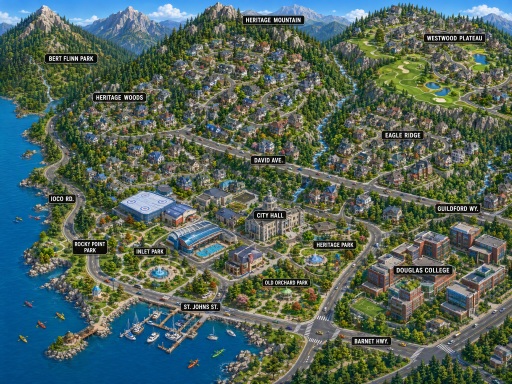
From Rocky Point Park to Ioco’s Craftsman homes and Moody Centre’s heritage streets, Port Moody has more than one story to tell. Explore the neighbourhoods, landmarks and home styles that shape this city, then find the plumbing service you need with The Crazy Plumber.
Legend
Surveyed by
The Crazy Plumber
Port Coquitlam HQ, serving all four regions
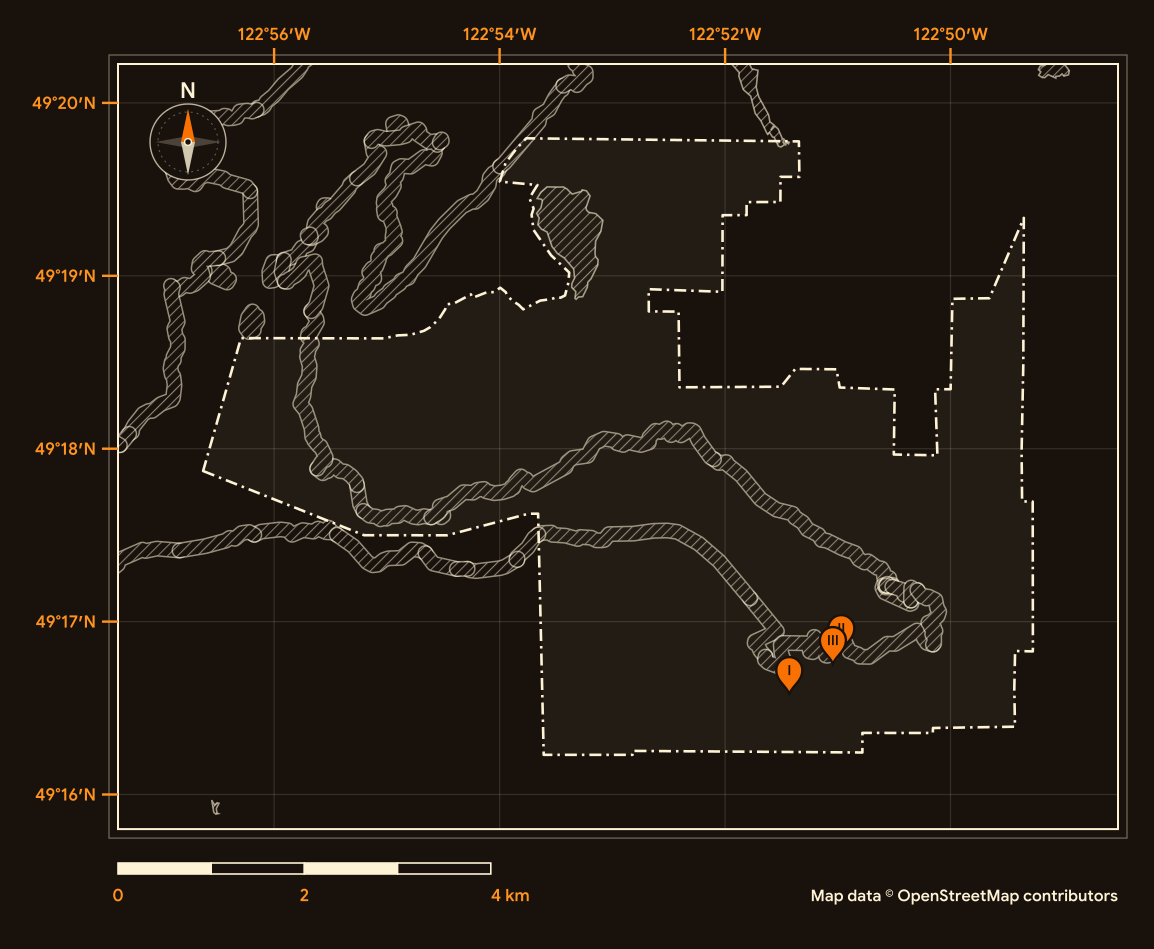
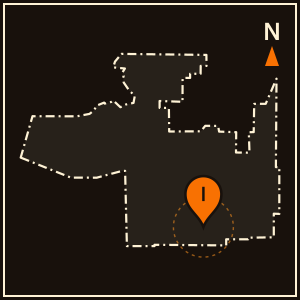
Pins I to III match the landmark plates; the dashed line is the city boundary. Map data © OpenStreetMap contributors (ODbL).
Location Landmarks
Three familiar places. Three different stories. Explore a heritage civic building, a waterfront park and a restored railway station.
Old City Hall (PoMoArts)
In 1978, Old City Hall received one of Port Moody’s first municipal heritage designations.

Rocky Point Park
A 500-foot recreational pier was added in 1988.
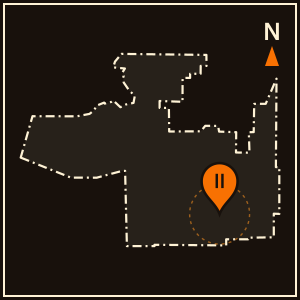

POMO Museum
The museum opened on July 1, 1983, and includes the Venosta, a restored 1921 sleeper car.
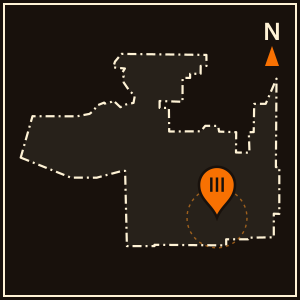

Your Home, Your Community, Your Plumber.
Ready to sort out your plumbing?
Tell us what is happening at home. Request a plumbing appointment online, or call to discuss the next step.
Credentials on file
Licence
TSBC Licence # LGA0213328
Better Business Bureau
Accredited · A+ ratingGoogle reviews
854
Founded
June 2023, Port Coquitlam
Estimates
Free estimates
Karn and Brad came out to help us with a blockage that backed the water into our living room and immediately diagnosed the issue and identified the fault with the city side of the line. Great turnaround and will be working with them in the future.
Brad is very knowledgeable and really helped figure out our plumbing needs. He explained the problem and the solution in a detailed manner and was extremely respectful. I would recommend working with Brad and The Crazy Plumber.
Fantastic service, fast, reliable, and a fair price I got my hot water tank replaced by Brad, and he was amazing
Karn came by and installed a new hot water tank, he ran me through the considerations and was very informative. gave me some advice on some other small considerations in the home and felt like i was dealt good information. I will call the crazy plumber again
This company is exceptional. Our plumber Brad skillfully and efficiently sorted out a number of issues at our house. The charges were reasonable and the response time very quick. He was also kind and easy to work with. It is clear this company wants to earn its customers and keep them.
This is the second time I received service from Brad, and I am always very grateful for his excellence, advice and his professionalism. I will use his service again and highly recommend him!
Location Data
See how Port Moody’s population has changed, what kinds of homes it has, how old they are and who calls it home. Explore five views of the 2021 Census.
Residents
33,535
Earlier census
33,551
Census year
2021
Comparison year
2016
People per square kilometre
1,297.3
Land area (km²)
25.9
Private dwellings
13,603
Occupied by usual residents
13,109
Average household size
2.6
Households of one person (%)
22.5
Median age in years
41.6
Ages 0 to 14 (%)
16.5
Ages 15 to 64 (%)
69.1
Ages 65 and over (%)
14.4
Average age in years
40.7
Ages 85 and over (%)
1.2
Single-detached (%)
30.1
Apartments, 5 or more storeys (%)
14.5
All other home types (%)
55.5
Households that own (%)
75.6
Households that rent (%)
24.5
Median home value, owner-estimated
$1,000,000
Built 1981 to 2000 (%)
29.0
Homes built 1981 to 2000
3,800
Built before 1981 (%)
33.1
Built 2001 to 2021 (%)
37.9
Needing major repairs (%)
5.0
Homes needing major repairs
655
Historical Timeline
A railway terminus, a refinery townsite and a new SkyTrain line. Explore three turning points that helped shape Port Moody.
1886
The first train arrives
Port Moody was chosen as the western terminus of the Canadian Pacific Railway in 1879. On July 4, 1886, the first scheduled transcontinental passenger train arrived from Montreal with about 150 passengers. The following year, the line was extended west to Vancouver.
1915
A refinery on the inlet
Imperial Oil bought 83 acres of waterfront in January 1914, and refinery operations at Ioco began in January 1915. After a 1918 strike secured an eight-hour workday, the company built a planned townsite for its workers between 1920 and 1923.
2016
SkyTrain reaches Port Moody
The Evergreen Extension of the Millennium Line opened on December 2, 2016, adding 10.9 km and six stations. Moody Centre station became a hub linking SkyTrain and West Coast Express.
Neighbourhoods
Explore three different sides of Port Moody: Ioco, Moody Centre and Heritage Mountain. Choose a neighbourhood to see its homes, streets and setting.
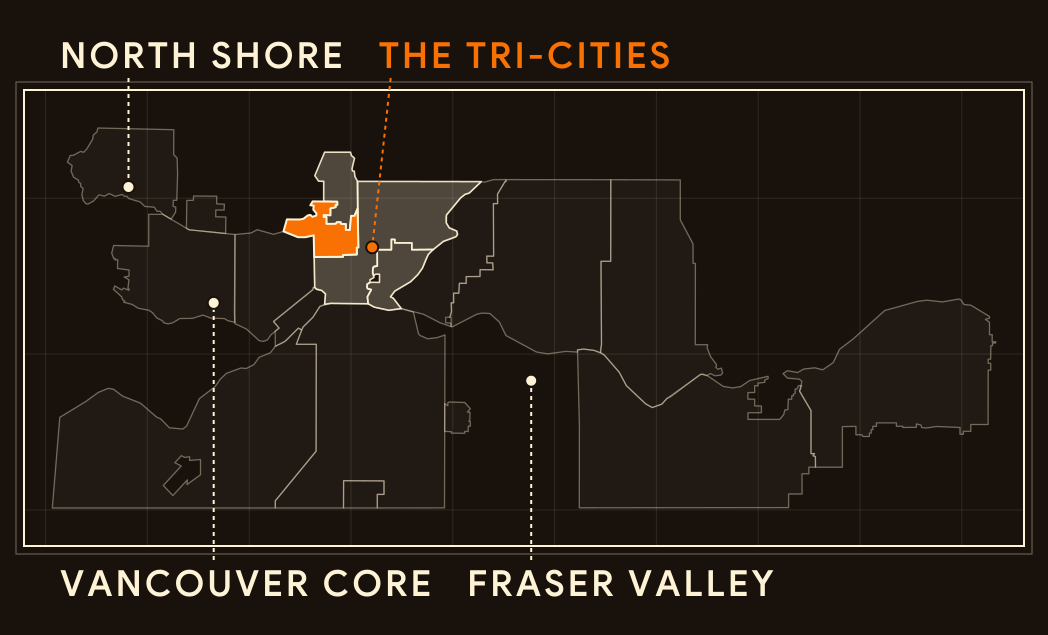
Regional key
The Tri-Cities
Map data © OpenStreetMap contributors (ODbL)
Ioco
A historic company townsite on the north shore of Burrard Inlet, named after the Imperial Oil Company.
Homes
Craftsman homes for refinery workers
Between 1920 and 1923, the Ioco Townsite Company built 81 Craftsman-style houses. Homes were sold on an installment plan and allocated by job rank. A handful survive today.
Streets
A complete little town
The townsite included a school, two churches, a community hall, a lawn bowling green, tennis courts and a baseball diamond. The school, the hall and the Ioco Groceteria still stand.
Setting
Reached by water
Until road access opened in 1925, Ioco was reached by water taxi or rowing. Today it is a Heritage Conservation Area.
Moody Centre
Port Moody’s original downtown at the eastern head of Burrard Inlet, shaped by the railway terminus.
Homes
Character homes on the slopes
South of St. Johns Street, residential streets climb the Chines, a steep forested slope. Early homes on large lots sit alongside townhouses and apartments of widely varying ages.
Streets
A village-scale main street
Clarke Street keeps an Edwardian-era village character, with one-and-a-half to two-storey wood-frame buildings. St. Johns Street developed later as a wider, car-oriented corridor.
Setting
Transit at the centre
SkyTrain reached Moody Centre station in December 2016, joining the West Coast Express, and the City plans mixed-use growth around it. Rocky Point Park sits on the waterfront nearby.
Heritage Mountain
A newer neighbourhood on Port Moody’s northern slopes, along Heritage Mountain Boulevard.
Homes
Houses and townhouses
The City describes Heritage Mountain as relatively new, with a mix of single detached homes and townhouses plus a small number of apartments. Its plan keeps the area’s residential and forested character.
Streets
A name, not a heritage area
Despite its name, Heritage Mountain is not one of the City’s heritage conservation areas. Port Moody recognises two: the Ioco Townsite and Moody Centre.
Setting
Next to the forest
Bert Flinn Park, about 126 hectares of forest with nature and mountain bike trails, is one of the sensitive areas the City’s plan commits to protect.
Builders and Developers
Meet two builders whose work helped shape Port Moody. Follow each story from the land to the buildings and the places people recognise today.
Edgar Development
Material
A large site gets a new plan.
Edgar’s Portwood redevelops Woodland Park, about 9.7 hectares at 1142 Cecile Drive and 300 Angela Drive. The site held 19 low-rise buildings from the 1960s with 200 townhomes.
Building
Homes rise in phases.
The plan calls for about 2,000 homes across 20 buildings of 6 to 19 storeys, including 325 below-market rental units funded by BC Housing. Umbra, one of the phases, includes 219 homes.
Community
Space for daily life.
Plans include about 1,770 square metres of commercial space, a childcare centre for 93 children, two parks and a 1.5-kilometre trail. Council adopted the rezoning in December 2021, with build-out expected by 2036.
The Ioco Townsite Company
Material
Forest cleared for a refinery.
In January 1914, Imperial Oil bought about 34 hectares of waterfront for $150,000. That March, 600 workers and teams of horses began clearing forest for the refinery.
Building
A company builds a town.
Between 1920 and 1923, the Ioco Townsite Company built 81 Craftsman-style wood-frame houses, along with a school, two churches and a community hall.
Community
A townsite remembered.
After the refinery closed in 1995, most homes were demolished or moved. The surviving school, hall, Groceteria and several houses are now part of a Heritage Conservation Area.
Styles of Homes
Recognise that roofline? Choose a home style, then explore the details that connect it with Port Moody.
Early 1900s to the 1920s
Buildings that meet the sidewalk
Along Clarke Street in Moody Centre, early wood-frame buildings sit on narrow lots and face pedestrian streets.
Modest scale
One-and-a-half to two-storey wood-frame structures with simple trim define this frontier vernacular style.
Built for a mill town
The style spread after the railway arrived and the city incorporated in 1913, serving merchants, mill workers and local businesses.
What remains
Old City Hall (1913) still stands on St. Johns Street. In 2019, a fire destroyed the 1913 Roe & Abernethy Grocery Store and the Gallery Bistro on Clarke Street.
1920 to 1923
Company-town Craftsman
In Ioco, modest Craftsman homes were built to a uniform scale for refinery workers. Look for simple wood-frame forms set evenly along the street.
Uniform by design
The 81 original company houses shared a consistent scale and uniform setbacks on a pedestrian-oriented street grid.
Modest details
Wood-frame construction and modest Craftsman detailing gave the townsite a unified look.
A house that moved
The Old Orchard Park Caretaker’s Residence, built around 1921 as part of the Ioco townsite, was relocated to the park in the mid-1970s.
Late 1990s onward
Homes that follow the slope
Heritage Mountain and Heritage Woods are relatively new hillside neighbourhoods on Port Moody’s north shore, set among forested slopes.
Houses and townhouses
The city’s Official Community Plan describes these neighbourhoods as a mix of single detached homes and townhouses, plus a small number of apartments.
Room for more homes
The plan expects small-scale multi-unit housing to arrive over time along the existing lot pattern, sometimes while keeping the existing house.
Close to the forest
City policy aims to keep the residential and forested character of Heritage Mountain, Noons Creek, Twin Creeks, Mountain Meadows and Heritage Woods.